Zum Inhalt springen

Print · Internationale Fachmagazine

Implants

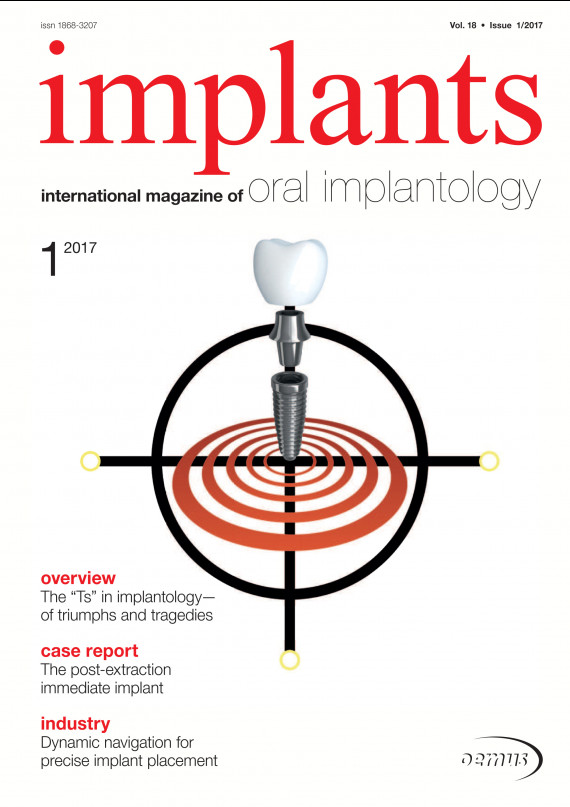
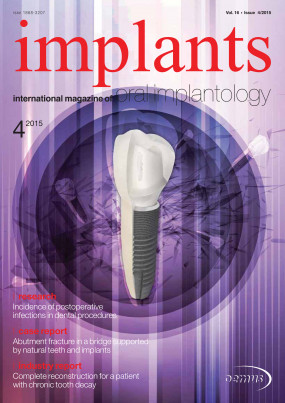
Mit Lesern in zahlreichen Ländern zählt implants – international magazine of oral implantology heute zu den weltweit am weitesten verbreite… Aktuelle Ausgabe 01/2017 – jetzt als E-Paper lesen oder als PDF herunterladen.

  • 78 Ausgaben im Archiv
  • Jahrgänge 2007–2026
Implants 01/2017
Ausgabe 01/2017

Übersicht

Über Implants

Mit Lesern in zahlreichen Ländern zählt implants – international magazine of oral implantology heute zu den weltweit am weitesten verbreiteten zahnmedizinischen Publikationen. Das englischsprachige Magazin wird in Zusammenarbeit mit der Deutschen Gesellschaft für Zahnärztliche Implantologie (DGZI) – Europas ältestem implantologischen Berufsverband – herausgegeben und fördert den internationalen Wissensaustausch in der dentalen Implantologie. Mit dem Anspruch, einen umfassenden Überblick über aktuelle Entwicklungen in diesem Feld zu geben, erscheint implants viermal jährlich. Es informiert seine Leserschaft mit einem breiten Spektrum klinischer Fallberichte, Updates zu relevanten Produkten und Methoden aus der Industrie sowie Nachrichten aus Wissenschaft und Forschung. Ein weiterer Schwerpunkt liegt auf der Berichterstattung über internationale Kongresse und den weltweiten Aktivitäten der DGZI. Gemeinsam mit ihren eigenen und assoziierten Mitgliedern ist die DGZI Teil eines Netzwerks von rund 11.000 implantologisch spezialisierten Fachleuten. Das Magazin wird direkt an Mitglieder und Abonnenten versandt und ist zudem als kostenloses Exemplar auf zahlreichen internationalen Fachmessen und Kongressen erhältlich.

Ausgabe 01/2017

Inhaltsverzeichnis

1
Titel Redaktion Kein Kurztext vorhanden. Bitte schauen Sie in die PDF oder nutzen Sie das ePaper.
3
Editorial: Full speed ahead – Implantology in 2017 Dr Rolf Vollmer 2017 seems to have plenty to offer with regard to implantology: The DGZI has already started invitations for its scientific awards presented at the 47th International Annual DGZI Congress on 29–30 September in Berlin/Germany. This includes the DGZI Implant Dentistry Award 2017 (5,000 EUR) as well as the DGZI Thesis Award 2017 (2,000 EUR). The final deadline for both of the two awards is 31 May 2017...
4
Content Redaktion Kein Kurztext vorhanden. Bitte schauen Sie in die PDF oder nutzen Sie das ePaper.
6
The “Ts” in implantology — of triumphs and tragedies Dr Georg Bach, Germany Implantology has become a commonplace in dentistry. Indeed, insertion techniques have progressed more and more in the past two decades, while the dental industry has provided users with improved implant surfaces and instruments. Hardly any other dental discipline has experienced more innovation and investments within such a short time span. These developments have been rewarded with a comprehensive product range and highly increased numbers of inserted implants that seemed out of reach only one and a half decades ago. However—despite all of this euphoria—implantology does not exclusively entail positive facets. Therefore, this article is designed to report on the “Ts” in implantology, on triumphs and tragedies...
16
The post-extraction immediate implant — A new approach for filling residual bone defects Prof. Dr Mauro Labanca, Dr Ernesto Amosso, Prof. Dr Luigi F. Rodella, Italy In international literature, a growing number of studies have assessed and quantified alveolar bone resorption following an extraction procedure. 1-4 After dental extraction, height and width of the residual bone ridge suffer a reduction that appears to be greater in the first 30 days 1 and about 50 per cent of the total resorption in the first 3 months 3 . The exact causes of this mechanism are controversial and currently under discussion. 4-8 In order to limit bone resorption after the act of extraction, several techniques have been proposed...
22
T R I N I A™ — Metal- free restorations Prof. Dr Dr Rolf Ewers, Paolo Perpetuini, Dr Vincent J. Morgan, Prof. Dr Mauro Marincola, Richard Wu, PD DI Dr Rudolf Seemann, Austria/Italy/USA There are several reasons not to use dental restorations made of metal. Possible disadvantages of metal are for instance the potential allergenicity (type IV allergy) and weight, density, as well as the long processing time. Furthermore, the colour of metals differs visibly from gingiva and teeth. Metal has in fact a great strength, but it is, however, much harder than the natural tooth. Metals are very good thermal conductors and isolate from temperature much worse than teeth. Every patient with deep fillings or cast gold inlays probably knows about these properties...
28
Dynamic navigation for precise implantation in cases of critical anatomy Dr David Burgess, United Kingdom Using the CBCT image as a map, dynamic navigation guides surgeons just like a GPS guides drivers. The clinician virtually plans where implants should be placed. During surgery, the navigation system dynamically tracks the drill and the patient’s jaw, providing guidance and visual feedback to ensure the implants are placed according to plan...
32
Osteo-mucous restoration and implantsupported overdenture Dr Ugo Torquati Gritti, Dr Daniel Vrespa, Buongiovanni Armando, Giancarlo Riva, Italy The improvements of living conditions and medical care in the Western world have helped to increase the live expectancy in the population. The simultaneous evolution of prophylaxis in dentistry has also influenced the raising age, in which edentulism manifests. Nevertheless, even in the presence of undeniable improvements in dental care there is registered an increase of edentulous patients that need a full rehabil - itation. Indeed, a statistical analysis carried out in the US in 1991 shows that 33.6 million people need a full denture and also points out that in 2020 this number will increase to 37.9 million people (Fig. 1)...
36
Interview: The RFA-technique must be accurate and reliable Prof. Lars Sennerby Resonance Frequency Analysis (RFA) is today a standard method to measure implant stability, but the measurement unit ISQ itself needs to be explained. Prof. Lars Sennerby is one of the developers and re earchers behind the RFA-technique and will sort things out for us below...
38
News Redaktion Kein Kurztext vorhanden. Bitte schauen Sie in die PDF oder nutzen Sie das ePaper.
42
Japan Annual Meeting 2016 of ISOI and DGZI in Tokyo Dr Rolf Vollmer From 12 to 13 November 2016, the annual ISOI Meeting of the Japanese DGZI fellow society took place in Tokyo. Having been founded ten years ago and now featuring more than 700 members, the International Society of Oral Implantology (ISOI) is among the most important DGZI partner societies. Both DGZI and ISO members greatly appreciated the palpable hospitality and close personal relationships during the congress...
46
News Redaktion Kein Kurztext vorhanden. Bitte schauen Sie in die PDF oder nutzen Sie das ePaper.
50
Congresses, courses and symposia/ Imprint Redaktion Kein Kurztext vorhanden. Bitte schauen Sie in die PDF oder nutzen Sie das ePaper.

Auszug aus dem Inhalt – das vollständige Verzeichnis finden Sie im E-Paper und in der PDF-Datei.

Weitere Hefte

Neuere Ausgaben

Weitere Hefte

Ältere Ausgaben

Weitere Titel

Ähnliche Ausgaben

Kein Heft mehr verpassen.

Abonnieren Sie diese Publikation im Shop – als Print-Abo direkt ins Haus, und Sie verpassen keine Ausgabe mehr.